

Published October 26, 2026
Every business owner understands the importance of attracting new customers. Considerable time, effort, and money often go into marketing campaigns, networking, referrals, and generating new inquiries.
But what happens after someone expresses interest?
A prospective customer sends an email requesting information. Someone calls to ask about pricing. A potential business partner requests a proposal. An existing customer mentions a future project.
The initial conversation goes well, but then the business gets busy. Other priorities take over, and the opportunity quietly slips through the cracks.
Sometimes, the biggest obstacle to business growth isn’t a lack of new leads. It’s the failure to follow up on the opportunities already in front of us.
Many businesses devote significant resources to attracting new prospects while overlooking the potential within their existing contact lists.
Consider how many names may already be sitting in your customer database:
These contacts represent more than names in a spreadsheet. They represent relationships that have already begun.
In many cases, a simple, well-timed conversation can reopen an opportunity that might otherwise have been forgotten.

Most missed opportunities aren't the result of employees being careless or uninterested. They're often the result of competing priorities and processes that haven't kept pace with the business.
In a small business, employees frequently wear several hats. The person responsible for responding to inquiries may also be handling customer service, processing orders, managing schedules, or assisting with daily operations.
Without a consistent follow-up system, it's easy for important conversations to become buried beneath more immediate tasks.
Common challenges include:
The result isn't necessarily a shortage of effort. More often, it's a shortage of structure.
When a prospective customer doesn't receive a timely response, the immediate concern is the potential loss of a sale.
However, the consequences can extend much further.
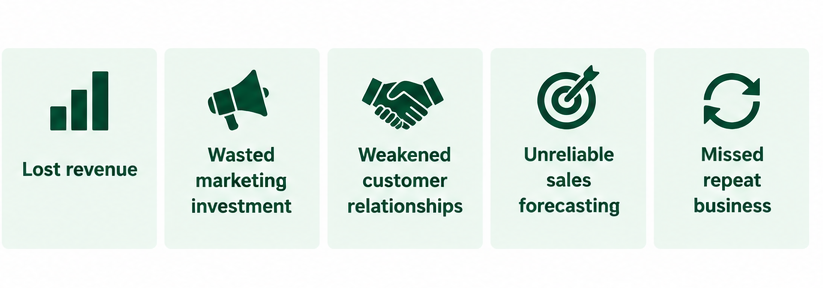
Over time, these seemingly small gaps can create a substantial difference between a business's potential and its actual performance.

Effective follow-up shouldn't feel like pressure.
It's about demonstrating reliability, understanding customer needs, and remaining available when the timing is right.
A customer who wasn't ready to purchase three months ago may be ready today. A business contact who previously declined a proposal may now have a new budget or different priorities.
The key is maintaining thoughtful, professional communication.
That might mean checking whether a customer needs additional information, asking how a previous purchase is performing, or simply reconnecting to learn whether their circumstances have changed.
Consistency builds familiarity. Familiarity builds trust. And trust creates opportunities for lasting business relationships.

Artificial intelligence and automated communication tools have become valuable resources for businesses of every size. They can help organize customer information, generate reminders, prepare communications, and ensure important follow-ups aren't forgotten.
Used thoughtfully, these tools can save time and improve efficiency.
But there's an important distinction between automating a process and building a relationship.
An automated email may remind a customer about an outstanding proposal, but it cannot fully replace the value of a genuine conversation. A personalized telephone call provides an opportunity to listen, ask questions, understand concerns, and recognize opportunities that might never surface through a series of automated messages.
Customers want to feel heard, understood, and valued—not simply processed through a sales pipeline.
That doesn't mean businesses should avoid AI or automation. Quite the opposite. Technology can handle repetitive administrative tasks, organize information, and help employees stay on top of their responsibilities.
The goal should be to use technology to create more time for meaningful customer interactions, not to eliminate them.
A well-organized CRM can remind you when it's time to reconnect. AI can help prepare for the conversation. But the relationship itself still deserves a human touch.
In a business environment increasingly driven by automation, genuine personal attention can become one of your strongest competitive advantages.
Before investing more money in lead generation, take a closer look at the contacts you already have.
Identify inactive customers, unanswered inquiries, outstanding proposals, and prospects who previously expressed interest.
You may discover opportunities that require little more than renewed communication.
Every meaningful customer conversation should conclude with an identified next action.
Will someone send additional information? Schedule a telephone call? Prepare a proposal? Check back in two weeks?
When the next step is documented and assigned, the likelihood of an opportunity being forgotten decreases.
A customer relationship management (CRM) system can help centralize contact information, conversation history, follow-up reminders, and sales opportunities.
However, sophisticated software isn't always necessary to begin improving your process.
Even a well-maintained spreadsheet can be effective when employees consistently update records and take ownership of follow-up responsibilities.
The important factor isn't simply having a system. It's using that system consistently.
Rather than waiting until business slows down, establish dedicated time for reviewing outstanding opportunities.
A brief daily review of unanswered inquiries, upcoming follow-ups, and inactive accounts can help keep important conversations moving forward.
Consistency often matters more than the amount of time invested.
Many businesses measure how many new inquiries they receive, but fewer examine what happens afterward.
Consider tracking:
These measurements can reveal where improvements are needed and help business owners make better-informed decisions.
When business owners recognize that opportunities are being overlooked, their first instinct may be to hire additional help.
Sometimes that's the right decision.
But before adding another full-time position, it's worth evaluating how existing responsibilities are organized.
Are employees spending time on activities that could be streamlined? Are customer inquiries reaching the right person? Is someone clearly responsible for maintaining contact with prospective customers?
Could targeted administrative or business development support free existing employees to concentrate on the activities that contribute most directly to growth?
A review of current processes may uncover opportunities to improve performance without significantly increasing overhead.
Business growth doesn't always require a larger advertising budget, a new marketing campaign, or hundreds of additional leads.
Sometimes, it begins with a telephone call that should have been made last month, a proposal that deserves another conversation, or a former customer who would welcome hearing from you again.
The opportunities may already exist.
The challenge is making sure they receive the attention they deserve.
At PSL Business Services, we help small and growing businesses evaluate their existing processes, strengthen customer relationships, organize sales activities, and identify opportunities for sustainable growth.
Our Business Development and CRM & Sales Analytics services are designed to provide practical support that complements your existing team—helping employees focus on the activities that contribute directly to business growth.
Reevaluate. Refocus. Regroup. Grow.
Learn more at www.PSLBusinessServices.com
PSL Business Services | Helping Businesses Grow.